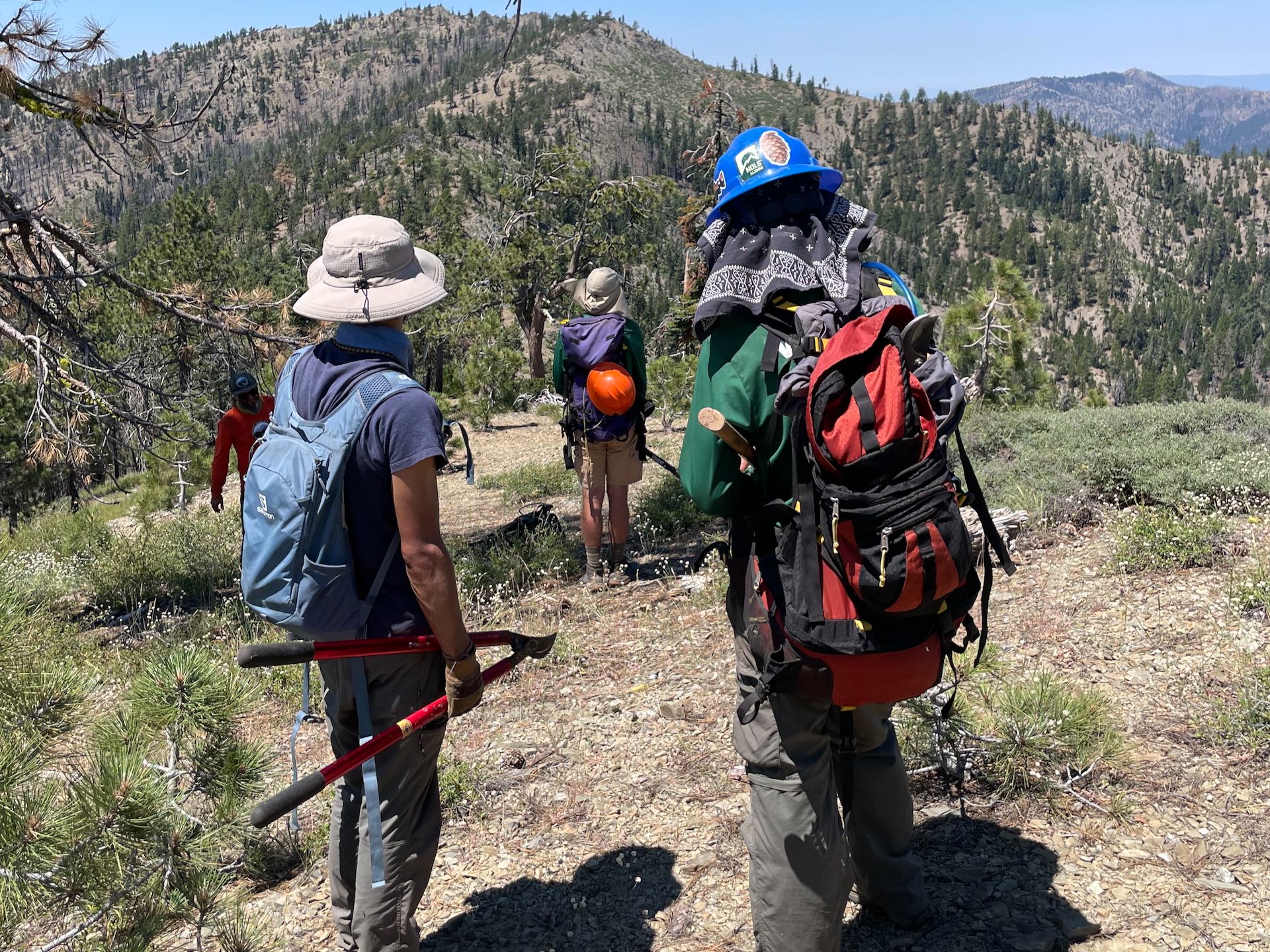
Some time ago, Owen made mention that he would like to work doing trail maintenance. That caught my attention. I knew that trail work would be a great opportunity for growth and I was interested in the prospect of finding a project for him to get involved with. Mostly, it would be something fun for us to do together.
When I received an email from the Bigfoot Trail Alliance, advertising their volunteer opportunities, there was obvious serendipity. I checked with Owen and he was absolutely interested in doing it. I reached out to the Bigfoot Trail Allianceand they were happy to add us to a trip they planned for in July.
Owen and I took advantage of this tremendous opportunity to work in the mountains this summer.
Early summer was perfect for getting prepared. We made sure Owen had a full backpacking kit. I was able to piece together a cooking outfit for each of us. Owen got a backpack and a sleeping bag for his most recent birthday.


Preparing meals for both of us as well as another week’s worth of food for my follow up trip was intensive. I dehydrated 21 days of meals, two weeks worth for me and a week’s worth for Owen.

My new and favorite method of food prep involves pre-packaging dehydrated meals to easily re-hydrate and heat in a Thermos.

A special meal: leftovers from Michele’s birthday party
I learned this method from The Backpacking Chef website. Backpacking Chef Glenn’s site has really helped me elevate my backcountry meals.
The project was scheduled to start on the 5th of July. Most of the group would stage on the evening of the 4th, at a trailhead that approached our base camp of Frying Pan Lake from the west.
I thought it might make more sense for Owen and me to approach Frying Pan Lake from the east, our side of the range.
To try to make it into camp by early evening, Owen and I had a very early start.

I had wondered what going all of the way up Paskenta Road would be like so I was curious. I also wanted to get some insights on what the trail was like starting out of Ides Cove which is the “official” start of the Bigfoot Trail (Southern Terminus). I was going to hike that section again on my through hike with Loren the following week.
In hindsight, I am not sure that I made the best plan. On one hand, we did get to experience the entirety of Paskenta Road as is winds up into the mountains. We also learned a lot about the trail and its particular challenges that were quite useful for the subsequent hike.
Despite these advantages, the hike was too far for Owen and me. It was especially too far considering the extreme heat storm that we were experiencing at the time.
Access to water is limited in much of the Yolla Bolly Mountains.

The trail is deceiving. There is abundant water for the first two miles, then little if any for the next ten.
Reaching snow at the highest part of the trail was fun and exciting. Little did we know how much elevation change we had for the rest of the day.

The High Point of the Bigfoot (7,500 ft.) overlooks the Eel River drainage to the west and the Cottonwood Creek drainage to the east.

The hike was beautiful.
We discovered a very cool plant. Balloon Milkvetch “blooms” along the ridges here. We wondered a lot about why and how this plant blows up its balloons.

Slowing us down was “deadfall”. Fallen trees, many of which were killed by fire, blocked the trail several places along the way. It takes time and energy to figure out the best way over, through, or around each time. These trees slowed us down substantially.

Owen and I learned how to hike this section. The secret is to stay as high on the ridge as one possibly can. Staying on top of the ridge rather than trying to follow trail has two advantages and one disadvantage.
The first advantage is hiking on level ground rather than on the side of each knoll. Hiking on one side of a ridge, wears on the uphill side of the feet.

The second advantage is accessing the cooling updrafts that treat you at the edge of each ravine. Sometimes, we could stand with updrafts hitting us from the east and west at the same time. Finding a shady spot while in the wind offers mini “cooling machines” to help the hiker recover from extreme heat.

The disadvantage is that the ups and downs are much steeper. There are many times on the Bigfoot that the hiker wishes someone had thrown some switchbacks into the trail. At least the sides of your feet don’t ache as much going straight up and down.

D Camp
We were very fortunate that there was a water source half way along our route at D Camp. Although the spring was a shallow pool fed by a trickle, it was enough to fill reserves for the rest of the hike.

It was at D Camp where Owen and I experienced our first unnatural phenomena on the trip.
Frying Pan Lake
When we finally rolled into camp to meet the rest of the group, we were absolutely destroyed. We also arrived three hours late. I am sure that we caused some distress for the group and I feel that wasn’t very considerate.

We also missed out on some team bonding with our group. By the time that Owen and I arrived, the rest of the group was on friendly terms and already getting along. We caught up, but I would have gladly spent another evening with the group.
Regardless, we made it to Frying Pan Lake, our home base for the project.

Frying Pan was a lovely spot to regroup after work and camp comfortably.
The camp has a cold water spring where we could easily fill water bottles with clear, cold water.

Trail Work
Our group was a great mix of inexperienced trail workers like ourselves and experts. We were given an orientation to the tools and we set out the next morning.


We learned by doing. We would hack at bushes and our leaders would teach us which bushes needed to be removed and how far back. We would scrape at the trail with rakes, and the leaders taught us how to shape the trail to discourage erosion.
Of particular interest was sawing logs. Our leader Jacob is a licensed “sawyer”. He supervised all of the sawing efforts. Sawing logs is an involved process. Safety is the primary concern. Care for the saw is also a priority.
Everyone enjoyed sawing. Despite the hard work in extreme heat, it is an empowering activity. Progress is readily made and with concerted effort, we get extraordinary results.

We started as early as possible, we took several breaks in the shade, and made significant improvement to the trail.

The section of trail that we worked on was Bigfoot Trail adjacent. Just above Frying Pan Lake is a loop hike that takes a hiker up the Willow Creek Basin.
Of interest on this hike are the gnarled Curlleaf Mountain Mahogany that are clearly very old and quite noble.

Over the following two days we continued to improve the Willow Basin Loop. The actual names for these trails are Wrights Ridge Trail and Long Ridge Trail.
The days were hot but our group was very positive. We worked hard and had a great time.

My favorite activity was scraping the trail with a McLeod which is a combination between a rake and a hoe. My partner and I began to work efficiently. He would cut the trail and I would round off the edges. He and I worked straight down the side of the Windy Mountain and built a hell of a trail where there was almost none.

Owen’s partner would hold back bushes and shrubs while he cut them off with loppers.

I am particularly proud of Owen. He worked very hard and did a great job.

He suffered some, grew a lot, and has a lot to be proud of.

Camp
Each evening, we were spoiled back at camp. Our leaders left water soaking in the sun, getting hot for showers. They also cooked huge meals. We played cards, chatted, rested, and enjoyed the meadow and each other’s company.

Sadly, the day of our departure rolled around. I know that Owen was itching to get back to civilization but I was just coming into my own.
I was intrigued to hear Owen say that he heard all of the adults talking about how they finally feel like themselves again out in the wilderness, cut off from all of the daily hassles and hustle and bustle. Owen expressed that he felt somewhat anxious about what he was missing out on back at home. I think about that. I guess that is how things should be at his age and mine.

Hike Home
I was anxious about our hike back to the car at the trailhead. The heat did not slack, the distance was just as far, and the way back trended uphill.
We decided to take advantage of our “rest day” to get a head start out of the wilderness.

The hike was difficult. It was extremely difficult. At one point, Owen was suffering from some heat stroke. We clambered into the shade and wind at the top of a ridge and recovered for an hour.
We tried to time our stints of hiking to take advantage of the shade of scarce clouds.
The Yolla Bolly Mountains are rugged and beautiful. We hiked late into the evening.


Afterthoughts
I am so fortunate to have had such a powerful experience with my son Owen. I love the wilderness and I love my boy. Working on such a positive project was life changing for both of us.
I will never forget this time in the headwaters of the Eel River. We both agreed that we would come back out here some day to appreciate and show off our work. I hope we might come back together.

The Bigfoot Trail Alliance published a very informative report on the work they got done this summer including the work that we did.
Yolla Bolly – Middle Eel Wilderness 2024
Owen looking over the Cottonwood Creek watershed and the Northern California Costal Mountain range
My summer holiday continued with an outstanding trip to Bend Oregon with Michele.
I then had the privilege of returning to The Bigfoot to backpack the first section of the Bigfoot with my great friend Loren.
The Bigfoot Trail – Section 1