Noah was kind enough to drop us off at the trailhead. It was great to share some unexpected time together. I am sure that he was surprised by how far back we took the road, 20 miles of which were dirt.

Day 0

Thanks to my experience with Owen just the week before, I knew that it would be a tremendous advantage to get into the backcountry a bit and get a jump on Day 1. Loren and I set off just before sunset.

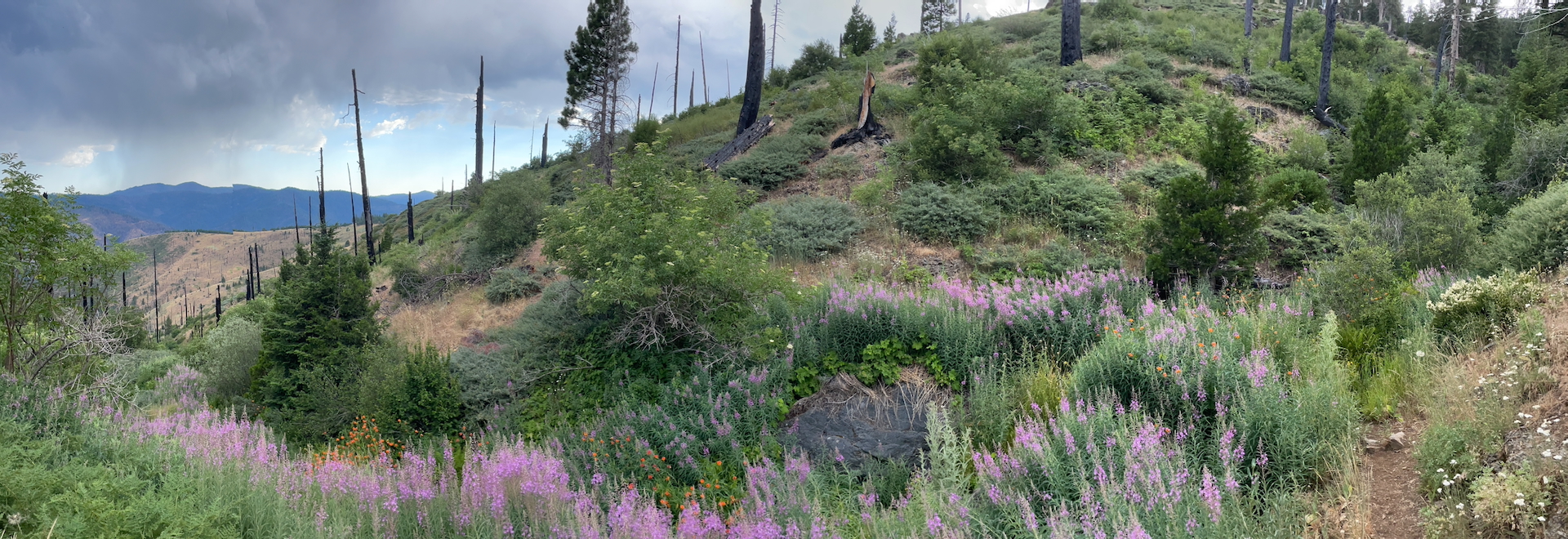
Burned sections of forest are a sad and common sight within the Yolla Bolly Wilderness. The first two miles of trail are also distinct from the rest of the Yolla Bolly / Eel River sections of the Bigfoot. The initial section is blessed with water. There are springs and stream crossings. This water creates several lush meadows. It is helpful to know that the last easy access to water is right around the corner.

We made our destination for Night 0 which was Long Lake. We got our tents up before dark, enjoyed a meal and got to sleep.

That evening we had a delightful rain storm. The sound of rain woke me and I enjoyed the coolness and the sound of rain until I fell back asleep.
Day 1
The overcast morning made it a delight to hike. Loren and I were intent on finding a grove of very special trees. We had heard that they were special and we were not disappointed. Without the favorable weather, I do not think we would have made it to them.

We accessed the ridge line by scrambling up to it directly from the trail. It seems like there might be a way to hike to this grove by taking the Mt. Linn Trail from the junction just a bit further down trail at the “High Point”.

The Foxtail Pines were gorgeous. They are quite distinct and somewhat showy.

Once we found the grove, the Foxtail Pines made themselves evident.
Finding this grove and spending time with these beautiful trees on a cool and cloudy morning was one of my highlights on this trip.

The “High Point” along the Bigfoot Trail is one of the highest elevations along the trail. Section 1 is an overall descent from here. There is a trail junction, a spectacular view over the mountains, and even snow. It was surprising to me how much snow had melted since I had been there less than a week before. On our way out, we had to cross over snow. I doubt there is much left anymore.
At this point, the snow does not run off as it melts. The water seems to sink directly into the ground. There was no access to water here and there is not easy access to water for another 10 miles. The evaporating snow should be taken as a warning to the attentive.

On our hike the previous week, Owen and I learned how to hike this section. The secret is to stay as high on the ridge as one possibly can. Staying on top of the ridge rather than trying to follow trail has advantages.
Another sign that things had changed since my last visit was that the Balloon Milkvetch had popped. Owen and I had noticed these bizarre plants the week before and each “balloon” was pristine.
Apparently it was their time to pop.

Appreciating conifers is one of the features of the Bigfoot Trail. Loren was developing a pretty good eye for the different types of pines, firs, and cedars. I did my best to keep up with all of the learning available on the trail.


Loren agreed that it was a difficult hike to our destination. I had intended to show him some of the work that we had done the week before but by the time we got that far in, all we cared about was reaching our destination for the evening.
Thankfully there was water at D Camp. The tiny spring was barely trickling and the small pool had about two inches of somewhat scuzzy water. It was enough to get us to camp. I would not like to make this hike in the heat without loading 2 liters at this spring. I can not imagine hiking that route, in that heat, without having access to water at D Camp.
We have had two great water years. I imagine that the spring a D Camp does dry up by July some years.
It is probably possible to carry enough water out of Long Lake during milder seasons.
There is relief at the end of the day at Frying Pan Lake. Frying Pan Lake is not a lake. It is a beautiful meadow.

The campsite at Frying Pan Lake has a clean and cool spring just uphill. This was our home base while Owen and I worked on trail the week before. It is very comfortable at Frying Pan Lake, a mandatory stop on the Bigfoot Trail.

Day 2

The second day in was not nearly as dry as day one. Although we were water conscious throughout the day, there was plenty available at different springs and streams. Sometimes water shows up at unexpected places, other times, predictions about available water turn out inaccurate.


The hike on day two was long and diverse. The Bigfoot is made of steep climbs and frequent short traverses. I would characterize it as a difficult hike. It is challenging in several ways. The intense heat of this July made it quite a bit more extreme. In the afternoon we had a thunderstorm that cooled things off for the long traverse that afternoon. We were very fortunate.

After a steep climb and a section of limited water. The hiker is blessed with North Yolla Bolly Spring. This is an absolute Oasis in these mountains. It is a trail junction with a large flat area in the shade. The spring is incredible and creates a garden of wildflowers. We were so trail weary once we reached it that it was difficult not to set up camp. We took a long rest and ruefully decided that we needed to make more mileage.

incredible spring into a hollowed out log trough
The afternoon / evening traverse was long but its beauty prevented it from being a slog.

I have never seen so many grasshoppers as I did through the meadows. Come to think of it, another feature of the Bigfoot Trail is the amount and variety of insects. Bugs are everywhere. They can be somewhat bothersome because of their numbers but we did not have very much trouble with bites or stings. I learned that Loren really doesn’t like yellow jackets. I don’t even notice them but they are out in gangs on the Bigfoot. I am glad that Loren isn’t bothered by grasshoppers because they were innumerable.
Through this section we noticed that some sections of grassland are decimated by the grasshoppers.


By evening, we were somewhat concerned about water again. We had missed the “last good water” source and were too tired to hike back when we got to camp at the wilderness boundary. We decided that we could make do with the two liters that we had between us and hope for the best the following morning.
Owen had asked me to get a picture of the stars for him so that evening I made an effort to take some night sky images.

Day 3
We were somewhat anxious about water until we reached the trailhead. Once there, we discovered irrigation tubing that someone had set up to bring water to the horse corrals. We followed the tubing for at least a quarter of a mile to a stream. That was a lot of tubing someone has set up and left out there.

Relieved to have water, we hiked along the dirt road. It was easy going and we got to watch a bear cub scurry through the meadow below. We may have spooked him. It was amazing to watch a bear cover so much cross county distance so easily while we limped along a road.
The road walk was hot and mostly unremarkable. I did not take any photos. We did see some people for the first time in two days. Four forest service trucks passed by as we ambled down the road.
We arrived early in the day to the South Fork of the Trinity campground. It was wonderful to have enough water to swim in. The campground was somewhat developed with a “kitchen”. There was a latrine nearby with a built toilet. There were flat spots for tents and there was shade. It was a lovely camp.


Someone had left some underwear out to dry on some laundry lines. Loren was concerned about what might have happened to their owners and whether or not we were intruding. I pitched my tent to claim a spot and hung out my laundry alongside the rest of it. The owners never showed and Loren became concerned about what might have become of them.

Day 4
If not for the deadfall, I think that this would have been my favorite section of trail. The forest on this day had not suffered recent fire. The forest was dense and there was plenty of water. We had to clamber over or around many dead trees across the trail. It became quite frustrating. Dealing with the deadfall kind of put a damper on the hike overall.


owl feather
It was amazing to see huge banana slugs crawling along scalding hot and dry rocks. I had seen several banana slugs over the last couple of weeks. I always imagined them in more rainforest like terrain where I have seen them before but they are abundant in the Coastal Mountains.
Poor Loren had suffered an episode where he stepped on one and it went all over. He was upset because he is very sensitive to causing harm. In his distress, he accidentally stepped on another. I could not help but laugh, although I felt for him.

this slug remained un-stepped on
We came to Saint Jacques’ Place which is a type of ruins but we did not know anything about the history. Loren and I speculated on what might have been out here and who Saint Jacques was and what he was like. Loren’s view was more optimistic than mine.

The oak woodland in this area has a lot of burrs. They get caught up in whatever touches them. They did not seem to grab onto my pant legs but they loved Loren’s gaiters and socks. They were tough to get out.


Camp that evening was along the stream Smoky Creek (Smokey? there are discrepancies with the spelling). There are more ruins of cabins in the area.

the crawdads are particularly colorful in the small streams of the Costal Mountains
Day 5
Heading out of Smoky Creek is a steep climb. We started early to beat the heat. Someone had been doing some trail maintenance in the area because a tool got left behind. On trail crew the week before, I learned that this tool is called a Pulaski and in the right hands, it is incredibly useful for building trail.


Shortly after reaching the road, we saw people again. This time it was a friendly older couple rambling down the road in a fairly beat up pick-up truck. They pulled over and were excited to see us. “Are you Bigfooters?” they asked. They told us that they lived in these mountains and were familiar with the Bigfoot Trail. They had not met any actual “Bigfooters” yet. They had read Michael Kauffmann’s book and were sad that the Mangroves “that he loved” had been burned.
With a wink, they offered us a ride to the highway in the back of their truck. We should have accepted the offer.


The hike down this section of gravel road was exposed, hot, and dry. By the time that we got to Rattlesnake Creek, we were pretty miserable. The air also started to get smoky. I couldn’t fathom continuing past Rattlesnake Creek but Loren insisted that it was not a good place to camp. I am glad he insisted.
I took a long rest creekside and recovered. We determined that it would be best to set out in early evening for the rest of the hike on the road.


It was still hot, exposed, and dry.
We were glad to have carried water from Rattlesnake because Bone Creek was bone dry. The landscape had been destroyed by fire, which made this section even more unpleasant.
We eventually made it to the highway where our road merged with it at the top of the ridge. We were very relieved to find that the highway descended the other side, mostly in the shade.
Seeing people in cars as they passed by both directions was somewhat surprising after such lonely country.


We were intent on finding someplace decent to camp before dark. The trail as it leaves the highway is still accessible by vehicle and many of the flat areas near the stream felt exposed or were full of trash from people partying roadside.
We eventually came to a meadow that was good enough. It had an abandoned car as a centerpiece.

Day 6
We started off the day on the lookout for Ghost Pines and we found them.

Otherwise the hike was fairly unremarkable. It is along a rarely traveled road. There is a section that is not passable by vehicles unless someone gets back there with a chainsaw.


Loren interpreted this as a sign that someone or something did not want us to pass. We passed.

As we got closer to our destination for the evening, Philpot Campground, we began to find unfortunate signs of “civilization”.


We made it to Philpot early in the day. It is a neglected, almost abandoned, campground. However, the pit toilets were tidy and stocked with toilet paper. We had the campground to ourselves. We fixed up the site: propped up the picnic table, cleared the broken glass, and picked up quite a bit of trash.

This is the summer of the Western Tanager for me. I have been blessed to enjoy them several times this year.
Thankfully, there is a stream for water and even a lovely swimming hole.

The swimming hole was directly upstream from a tangled mass of fallen logs and debris. It certainly did look like it could be a den for a bipedal cryptid of significant stature adjacent to which we found some sort of satanic ritual site.
There were signs of animal sacrifice and “magical” odds and ends were strewn around. It was too much for Loren and it ruined his ability to enjoy the swimming hole.

We read that there may be a waterfall nearby and we went to look for it. We did not make it very far until the heat beat us back to the shade of our campsite. We were in bed by 7:00 having beaten the heat.

Day 7
We were so looking forward to a great hike to end our trip. We were excited to spend the last several miles on trail rather than road. Sadly, the day was somewhat of a bust.
We looked for the trailhead near our campground. Someone had cut something that looked like a trail but it was a dusty scramble straight up the side of a hill. We would have to scale straight up a dusty dirty hillside. An adjacent trail sign led into a thicket with fallen log across it. Either way did not look promising.
We decided to stay on the road until we could find better trail at the top of the ridge.
I did eventually find the trail midway up the road and clambered up. Loren missed it and kept to the road. I don’t think this quarter-mile of trail added much to the hike and I would have stuck to the road if I had it to do again.


At the top of the ridge, the trail into East Thule Creek was easy to find. It was not long before we lost the trail again.
I will say that the Thule Creek section of the trail is not in any condition to hike. I do not recommend this section and I actually warn against it. The trail here has not been maintained in a long time. To say it is overgrown is an understatement. Not only did we have to bushwack, there is deadfall throughout. In some parts there is deadfall that is enveloped in overgrowth on steep aspects. I felt this hike was actually dangerous.
Loren and I were also stressed because we had a schedule to keep. Our buddy Chris was picking us up at Thule Creek Road. We cursed and crashed our way through Thule creek. We lost the trail several times and had to reorient ourselves using the gps. It would be very lovely in that area if it were at all accessible. It was a shame to have to end our adventure with this hike.

All in all, I really enjoyed hiking the Bigfoot. It was a very difficult hike and Loren and I stayed positive and had fun during most of it. Loren and I agreed that we probably would not hike Section 1 again with so many epic backpacking trails available throughout the Sierra and Cascades but we were happy to have done it.
We are going to continue to hike the next 290 miles of the Bigfoot Trail and complete it before 2030.

Tradition dictates an end of the trail stop at a Mexican Restaurant. The Mexican place in Hayfork is outstanding. It is like walking off the road and into Mexico. The food was delicious, they had vegan options for Loren, and the señora was so friendly. I hope that Bigfooters bring them business.
